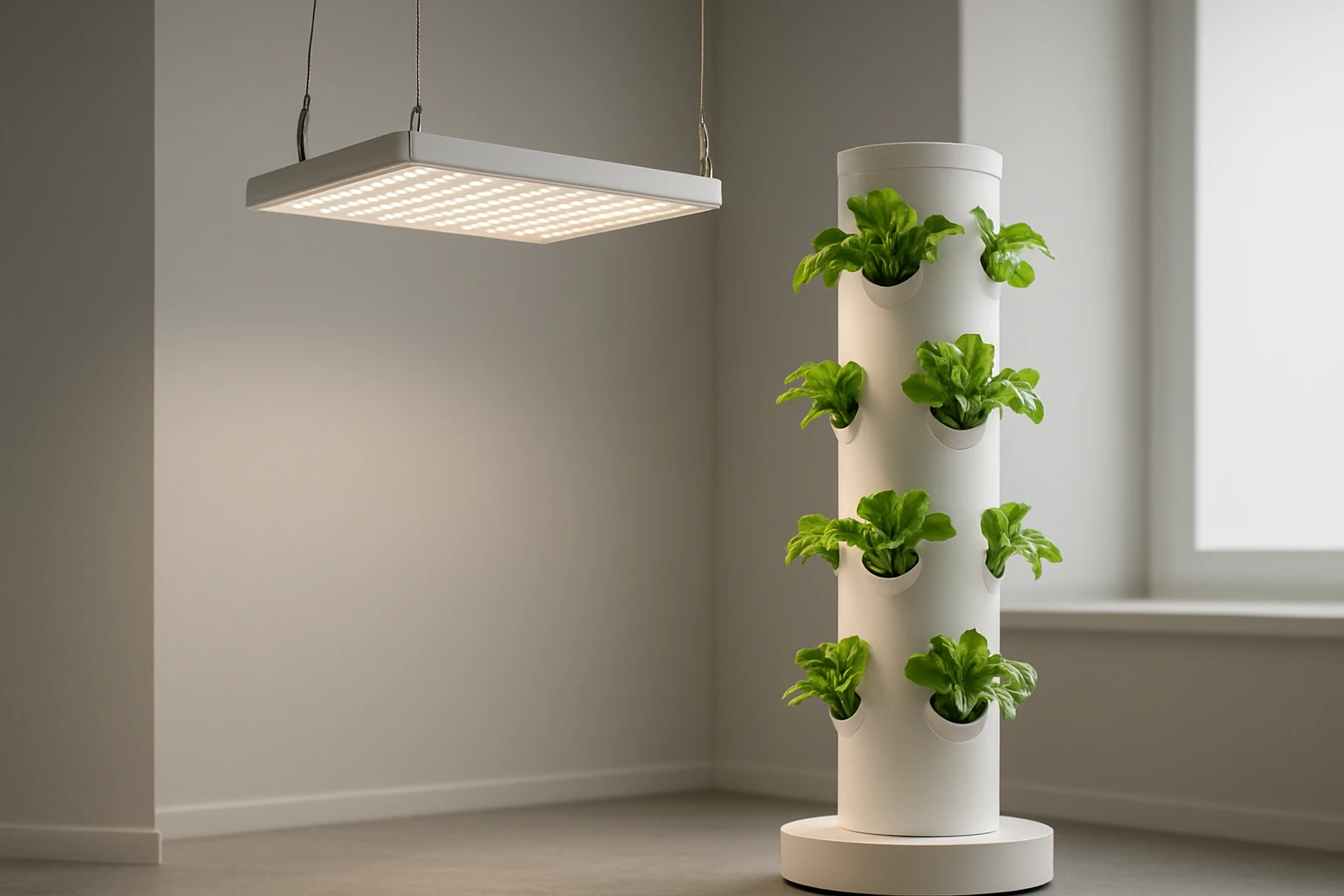
How to Position Grow Lights in Hydroponic Towers: Optimal Height, Distance & Angle for Maximum Yield
Introduction
This guide explains how to arrange artificial lighting for hydroponic tower systems so that plants receive uniform illumination throughout their life cycle. Readers will learn the scientific basis for light placement, practical measurement techniques, and how to adjust settings as plants mature. The information is valuable because proper light positioning directly influences photosynthetic efficiency, energy consumption, and overall harvest quality. By following the steps, one can achieve higher yields while minimizing waste.
What You'll Need
- Measuring tape or laser distance measurer
- Adjustable mounting brackets or hooks
- Light intensity meter (lux or PAR meter)
- BESTVA DC2000 LED Grow Light – $107.49, 4.5/5 rating
- Barrina 4FT LED Grow Light 6-Pack – $94.99, 4.6/5 rating
- DYMOND BoostGro 2FT LED Grow Light – $21.98, 4.6/5 rating
Step 1: Assess Tower Dimensions and Plant Growth Stage
Begin by measuring the total height of the hydroponic tower from the base to the topmost planting node. Record the spacing between each tier, because light distribution must cover each level without causing hot spots. Identify the current growth stage—seedling, vegetative, or flowering—as each stage requires different light intensity and spectral balance. This assessment creates a baseline for selecting the appropriate height and angle for the chosen lighting solution.
Step 2: Determine Ideal Light Height
The optimal vertical distance between the light source and the canopy depends on the light's wattage and spectrum. For a medium‑size tower (approximately 5‑ft tall) the BESTVA DC2000 LED Grow Light performs well when positioned 12‑18 inches above the highest foliage during vegetative growth. Its 200‑watt consumption and full‑spectrum output mimic natural sunlight, providing 3000K and 5000K wavelengths that promote leafy growth. During flowering, raise the fixture slightly to 18‑24 inches to prevent leaf scorching while still delivering the 660nm red light essential for bud development. The built‑in quiet fans maintain a temperature of 50‑60°F, reducing heat stress on the tower.
Step 3: Set Horizontal Distance Between Light and Plants
Horizontal spacing ensures that each tier receives comparable photon flux. The Barrina 4FT LED Grow Light 6-Pack offers a coverage area of up to 3×3 feet, making it suitable for wider towers or multi‑tower arrays. Position each 4‑ft strip 12‑14 inches away from the outermost leaf edge to achieve a uniform PPFD of 400‑600 µmol·m⁻²·s⁻¹ for vegetative stages. The aluminum housing dissipates heat efficiently, allowing the lights to operate at lower distances without raising canopy temperature. For compact towers, a single strip can be centered above the tower, while additional strips can be staggered for larger installations.
Step 4: Adjust Light Angle for Uniform Coverage
Tilting the light fixture slightly outward (10‑15 degrees) helps distribute photons evenly across the vertical plane of the tower. The DYMOND BoostGro 2FT LED Grow Light features an inline switch and a linkable design, allowing multiple units to be daisy‑chained and angled independently. Use the linkable feature to create a stepped lighting pattern: attach one unit at the base, another at mid‑height, and a third near the top, each angled to target its specific tier. This configuration reduces shadowing and ensures that seedlings at the bottom receive the same spectral quality as plants at the apex.
Step 5: Verify Light Intensity and Spectrum
After mounting, use a PAR meter to measure the photosynthetic photon flux density at each tier. Aim for 200‑400 µmol·m⁻²·s⁻¹ during seedling stage, 400‑600 µmol·m⁻²·s⁻¹ for vegetative growth, and 600‑900 µmol·m⁻²·s⁻¹ during flowering. If any tier falls below target, adjust the height or angle incrementally by 2‑inch steps and re‑measure. The BESTVA DC2000 provides a sun‑like spectrum with 3000K, 5000K, 460nm, and 660nm wavelengths, while the Barrina strip delivers over 95% light absorption efficiency due to its reflector design. The DYMOND BoostGro adds a dedicated 660nm red channel that enhances flower initiation, especially useful for fruit‑bearing varieties.
Tips & Pro Tips
- Schedule a 12‑hour photoperiod for vegetative growth and a 10‑hour period for flowering to mimic natural seasonal changes.
- Rotate the tower 90 degrees weekly to prevent directional light bias and promote even canopy development.
- Utilize the quiet cooling fans on the BESTVA unit to maintain ambient temperature below 75°F, which is optimal for most leafy greens.
- When using multiple Barrina strips, connect them with the supplied cable ties to avoid accidental disconnection.
- Take advantage of the DYMOND's linkable design to expand the system without additional power adapters, reducing cable clutter.
Troubleshooting
- Issue: Leaves appear pale or elongated.
Solution: Increase light intensity by lowering the fixture 2‑3 inches or add an additional DYMOND unit to boost red spectrum. - Issue: Excessive heat at the top tier.
Solution: Raise the light height or activate the BESTVA's cooling fan mode; consider adding a small external fan to improve airflow. - Issue: Uneven growth between sides of the tower.
Solution: Adjust the angle of the Barrina strips by 5 degrees outward and verify PAR readings on the weaker side.
Conclusion
Proper positioning of grow lights in hydroponic towers involves careful measurement of height, horizontal distance, and angle to deliver optimal photon flux across all growth stages. By applying the steps outlined above and selecting tools such as the BESTVA DC2000, Barrina 4FT strip, and DYMOND BoostGro, growers can achieve higher yields, lower energy costs, and healthier plants. Continuous monitoring and minor adjustments ensure that the lighting system remains effective as the garden evolves.
Products Mentioned in This Guide
Frequently Asked Questions
What is the ideal height for placing grow lights over hydroponic tower plants?
Start with 12‑18 inches above seedlings and raise to 24‑30 inches as they mature, keeping light intensity within the recommended PAR range.
How far should the light be from the canopy for optimal photosynthesis?
Maintain a distance that delivers 400‑600 µmol·m⁻²·s⁻¹ for veg stage and 600‑900 µmol·m⁻²·s⁻¹ for flowering, typically 12‑24 inches depending on the fixture’s output.
What angle should grow lights be set to in a tower system?
Tilt lights 15‑30° toward the center of each tower to ensure even coverage and reduce shadows on lower leaves.
Which tools are essential for correctly positioning grow lights?
A measuring tape or laser distance measurer, adjustable brackets, and a lux or PAR meter to verify intensity.
How often should I adjust light height as plants grow?
Check plant height weekly and raise the lights 1‑2 inches each time the canopy approaches the lower limit of the recommended intensity range.