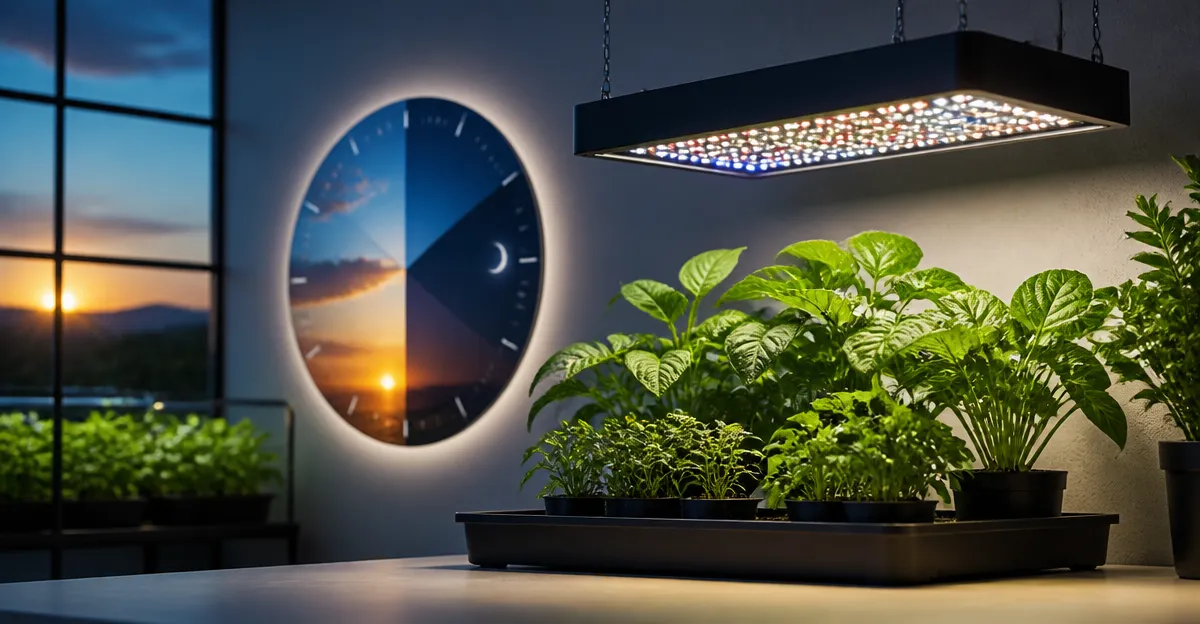
Grow Lights & Circadian Rhythms: The Ultimate Guide to Timing, Spectrum, and Their Effects on Plant Growth
Introduction
Indoor gardening relies on artificial illumination to replace the sun when natural light is insufficient. This guide explains how light spectrum, duration, and timing interact with plant circadian rhythms to influence growth, flowering, and fruiting. Readers will learn foundational concepts, practical strategies, and product recommendations that align with scientific principles. By the end of the article, one will be equipped to select and operate grow lights that maximize plant health while conserving energy.
Background and Context
Plants possess internal clocks that synchronize physiological processes with day‑night cycles. These circadian rhythms regulate photosynthesis, hormone production, and stress responses. Light quality, measured in nanometers, determines which photoreceptors are activated; blue light (400‑500 nm) drives vegetative growth, while red light (600‑700 nm) promotes flowering and fruit set. Full‑spectrum LEDs aim to mimic natural sunlight by combining blue, red, and green wavelengths, delivering a balanced photon flux that supports all growth stages.
Energy consumption is a critical consideration for indoor growers. Modern LED technology provides high photosynthetic photon flux density (PPFD) at low wattage, reducing electricity costs while delivering comparable or superior performance to traditional high‑pressure sodium or halogen fixtures. Understanding the relationship between spectrum, intensity, and timing enables growers to create efficient lighting schedules that respect plant biology.
Understanding Light Spectrum
The visible spectrum is divided into distinct bands that trigger specific plant responses. Blue photons activate cryptochrome and phototropin receptors, encouraging compact leaf development and strong stems. Red photons interact with phytochrome receptors, signaling the transition from vegetative to reproductive phases. Some growers supplement with far‑red or ultraviolet light to enhance secondary metabolite production, but these wavelengths are optional for most household plants.
Full‑spectrum fixtures combine blue and red LEDs with white diodes that emit a broad range of wavelengths. This approach reduces the need for multiple separate lights and simplifies wiring. When evaluating a product, examine the LED count, color temperature (measured in Kelvin), and color rendering index (CRI). A higher CRI indicates more accurate color reproduction, which often correlates with a more natural light quality for plants.
For example, the GooingTop Clip Grow Light uses 10 red and 74 white LEDs with a 6000 K color temperature and a CRI of 95, providing a balanced spectrum suitable for foliage and succulents. The Aokrean Halo Grow Light offers three spectral modes—white, warm white, and red—allowing growers to tailor the output to specific plant phases.
Timing, Photoperiod, and Circadian Rhythms
Photoperiod refers to the length of time a plant receives light each day. Many species require a defined day length to initiate flowering; short‑day plants flower when nights exceed a critical duration, while long‑day plants need extended daylight. Artificial timers enable precise control of photoperiod, ensuring consistent exposure regardless of seasonal variations.
Modern grow lights often include built‑in timers with preset intervals such as 3, 9, or 12 hours. However, flexibility is essential because optimal durations vary by species and growth stage. Beginners should start with a moderate photoperiod—approximately 12 hours for vegetative growth—and adjust based on plant response. Overexposure can cause etiolation (excessive stretching), while underexposure limits photosynthetic output.
Products such as the RWNTAO Clip Grow Lights provide a 3/9/12‑hour auto‑on/off timer with memory, allowing growers to set a schedule once and rely on the device to maintain it daily. The Barrina T5 Grow Light series does not include a timer but can be paired with external smart plugs for precise control.
Selecting the Right Spectrum for Plant Stages
During the seedling stage, plants benefit from higher blue light ratios to encourage sturdy stem development and leaf expansion. As plants mature, increasing red light promotes flowering, fruit set, and root elongation. Some growers employ a two‑stage approach: a blue‑rich phase for the first two weeks, followed by a balanced or red‑dominant phase for reproductive growth.
When choosing a fixture, consider the number of LEDs, the ability to adjust brightness, and the presence of multiple spectral modes. The Briignite LED Grow Bulbs deliver a full‑spectrum output in a standard A19 form factor, making them ideal for supplemental lighting in existing lamps. Their 4000 K white appearance hides the underlying red/blue mix, providing aesthetic compatibility with home décor.
For larger installations, modular systems like the Barrina T5 Grow Light allow up to 16 units to be linked, creating a uniform canopy of light over extensive grow tables. This scalability is valuable for hobbyists who expand their indoor garden over time.
Comparison and Selection Guide
| Feature | GooingTop Clip Grow Light | Aokrean Halo Grow Light (3‑Pack) | RWNTAO Clip Grow Lights (2‑Pack) | Barrina T5 Grow Light (4‑Pack) | Briignite LED Grow Bulbs (2‑Pack) |
|---|---|---|---|---|---|
| Price (USD) | 19.30 | 25.99 | 21.99 | 27.19 | 8.99 |
| LED Count | 84 (10 Red + 74 White) | 48 per unit | 42 (5 Red + 37 White) per bar | 96 per fixture | Full spectrum chips (equivalent to 100 W) |
| Timer Options | 4 h / 8 h / 12 h | 3 h / 9 h / 12 h | 3 h / 9 h / 12 h (memory) | None (external plug required) | None (continuous operation) |
| Adjustable Brightness | 5 levels | 10 levels | 10 levels | On/Off per unit | Fixed output |
| Mounting Style | Clamp with flexible gooseneck | Base or soil insert, telescoping pole | Clamp with 360° gooseneck, four heads | Clip and double‑sided tape, linkable | Standard E26 socket |
| Customer Rating | 4.5/5 (22,028 reviews) | 4.5/5 (3,476 reviews) | 4.6/5 (696 reviews) | 4.6/5 (6,936 reviews) | 4.6/5 (13,529 reviews) |
When selecting a product, match the fixture to the intended application. Clip‑on models excel for small pots and tabletop setups, while modular T5 strips are superior for large grow tables. Bulb‑type solutions are convenient for existing lamps and provide a low‑cost entry point. Consider power consumption, heat output, and warranty length—most of the featured items include at least a one‑year guarantee.
Best Practices and Tips
- Maintain a distance of 6‑8 inches between the light source and foliage to avoid photobleaching.
- Start with a conservative photoperiod (e.g., 10 hours) and increase gradually as plants acclimate.
- Combine blue‑rich and red‑rich phases to mimic natural seasonal transitions.
- Utilize external smart plugs or timers for fixtures that lack built‑in scheduling, such as the Barrina T5 Grow Light.
- Monitor leaf coloration and stem elongation; excessive stretching indicates insufficient light intensity.
- Rotate plants periodically to ensure uniform light distribution across the canopy.
- Take advantage of energy‑saving modes during daylight hours when supplemental lighting is not required.
Frequently Asked Questions
- What is the optimal PPFD for leafy vegetables? A PPFD of 200‑400 µmol·m⁻²·s⁻¹ generally supports vigorous leaf growth without causing light stress.
- Do I need ultraviolet (UV) light for indoor plants? UV light can increase secondary metabolites in some species, but it is not essential for basic growth and can shorten bulb lifespan.
- Can I use a single bulb to replace a full‑spectrum panel? For small collections of houseplants, a pair of Briignite LED Grow Bulbs can provide adequate illumination, but larger gardens benefit from panel‑type fixtures.
- How often should I clean the LED lenses? Dust accumulation reduces light output; cleaning the lenses monthly with a soft, dry cloth maintains efficiency.
- Is a timer necessary if I manually turn lights on and off? Manual operation is feasible, but timers ensure consistent photoperiods, which are critical for plants that rely on precise day‑length cues.
- What warranty should I expect? Most manufacturers listed here offer at least a 365‑day warranty, providing replacement or repair for defective units.
- Can I combine different products in the same grow area? Yes; mixing clip‑on lights with strip lights allows targeted illumination of high‑need zones while maintaining overall canopy coverage.
Conclusion
The interplay of light spectrum, intensity, and timing governs the health and productivity of indoor plants. By understanding circadian rhythms and selecting fixtures that deliver appropriate wavelengths and programmable photoperiods, growers can replicate natural conditions in a controlled environment. The products highlighted in this guide demonstrate a range of solutions—from clip‑on lamps to linkable T5 strips—each offering unique advantages for specific horticultural scenarios. Applying the best‑practice recommendations will help growers achieve robust growth, vibrant foliage, and abundant flowering while minimizing energy consumption.
Products Featured in This Guide
GooingTop Clip Grow Light
Price: $19.30 | Rating: 4.5/5 (22,028 reviews)
Featured for its high CRI 95, 6000 K full‑spectrum output, and convenient clamp with flexible gooseneck, making it ideal for tabletop and small‑pot applications.
Aokrean Halo Grow Light
Price: $25.99 | Rating: 4.5/5 (3,476 reviews)
Featured for its three spectral modes, 10 brightness levels, and telescoping pole, providing versatile placement for small plants and seedlings.
RWNTAO Clip Grow Lights
Price: $21.99 | Rating: 4.6/5 (696 reviews)
Featured for its 4‑head adjustable gooseneck, memory timer, and dual‑color LEDs, delivering flexible illumination for multiple plants simultaneously.
Barrina T5 Grow Light
Price: $27.19 | Rating: 4.6/5 (6,936 reviews)
Featured for its 5000 K full‑spectrum strip design, linkable architecture, and low power consumption, suitable for large grow tables and vertical farms.
Briignite LED Grow Bulbs
Price: $8.99 | Rating: 4.6/5 (13,529 reviews)
Featured for its standard A19 form factor, 100 W equivalent output at 11 W consumption, and ease of installation in existing fixtures.